
































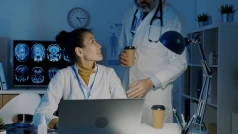

Dedicated Overnight Platform delivers better results for partners by supporting radiologists.
Ask any radiologist, and they’ll probably remember their first real stretch of nights.
The whole rhythm changes. Emergency CTs, limited histories, urgent calls — the worklist doesn’t care what time it is. Overnight, the reads are important. And in many cases, they are more immediate, with the next clinical decision waiting on the report.
That experience stays with you. It shapes how radiologists think about call, fatigue, recovery, and the kind of practice they want to be part of.
At Midwest Radiology, we’ve made it a practice-design issue. Our dedicated overnight platform grew from a belief that if overnight radiology is different, the way we support it should be different, too.
The work is measurably demanding.
Almost all radiologists have experienced the feeling firsthand, but research also supports that overnight radiology carries cognitive, clinical, and physical demands.
A study published in the Journal of the American College of Radiology found that after overnight shifts, radiologists were more fatigued, showed worse diagnostic performance, reported lower confidence, and took longer to review cases. The study also found increases in visual search effort, including more gaze fixations after overnight shifts.
Another study published in Radiology reviewed more than 10,000 body CT studies and found that clinically important interpretation errors occurred more frequently during overnight assignments than during daytime assignments. The same study found higher error rates in the latter half of night assignments.
The coverage model is very important.
It’s not that radiologists can’t work at night. They do, and many do it exceptionally well. Some even prefer overnight work when the role is structured around that rhythm.
A radiologist can often adapt to difficult work when the role is clearly defined and the structure around it makes sense. What wears on people is the feeling that overnight coverage gets mixed into an already full clinical load: rotate into nights, recover (sort of), return to days, and keep moving.
Over time, that kind of model can affect job satisfaction, energy, focus, family rhythm, and the culture of the practice itself.
Research on emergency radiology practice patterns has associated fewer annual night shifts and shorter shifts with greater job satisfaction. In a private-practice radiology burnout study, radiologists who took call (including evenings, overnights, and weekends) were statistically most likely to report burnout.
Radiologists know this. They have lived it, watched colleagues live it, or asked about it when evaluating opportunities. And the answers reveal a lot about how a group thinks about its people.
Some radiologists choose nights.
Let’s be honest. Not every radiologist wants the same practice pattern. Some prefer a traditional daytime schedule. Some are willing to rotate through call as part of the group. Others are drawn to dedicated overnight work because it can offer a different professional and personal rhythm.
A dedicated overnight platform recognizes that overnight radiology is a different kind of work, and some radiologists are better suited to it, more comfortable with it, or more interested in building their practice around it. A stronger model gives those radiologists a more defined role. It also protects the rest of the group from the disruption that can come from rotating shifts.
This takes coverage conversations away from what’s “fair,” and instead acknowledges different strengths, preferences, and ways of practicing well.
A dedicated platform is a radiologist-led decision.
Midwest Radiology’s dedicated overnight platform is more than an operational solution for hospitals and clinics. It’s a reflection of how our group thinks about radiology work.
Around-the-clock coverage is essential. Patients need answers at night. Emergency departments and inpatient teams need timely interpretations when decisions cannot wait. But providing that coverage well requires more than availability. It requires a model that recognizes overnight radiology as a distinct and important part of the practice.
That is what a dedicated platform is designed to do. The goal is to respect the work enough to build a model around it.
For overnight radiologists, it creates a role built around that rhythm rather than treating nights as an inconvenience. For daytime radiologists, it helps reduce the strain of rotating through overnight coverage. For the group as a whole, it supports a more sustainable way to meet the demands of 24/7 care.
Sustainability is part of quality.
Radiology depends on focus, judgment, and consistency. Those things are affected by the environment around the radiologist: workload, schedule design, expectations, communication, recovery, and support.
A dedicated overnight platform recognizes that radiologists are not interchangeable parts on a schedule. Different shifts carry different demands. Different physicians may thrive in different practice patterns. And the best model is not always the one that distributes every burden equally.
In a large, subspecialized practice like Midwest Radiology, our radiologists support hospitals, clinics, emergency departments, and outpatient imaging centers across the region. We work closely with care teams who depend on timely, accurate interpretations at all hours. Meeting their needs requires a strong clinical infrastructure. It also requires a practice culture that takes physician sustainability seriously.
The night platform says a lot about the group staffing it.
For radiologists considering where they want to practice, overnight coverage may not be the first topic that comes up. But it should be part of the conversation.
A group’s approach to night coverage shows whether it sees after-hours imaging as a coverage problem or as a meaningful part of patient care. It shows whether difficult work is simply distributed or thoughtfully managed. It shows whether the group is willing to build systems that support both its clinical partners and its physicians.
We are proud to support hospitals and care teams when they need answers most. But as a radiologist-led practice, we are equally proud to be part of a group that understands what that support requires from radiologists.